
So the Lucid Air is in the driveway — or it’s on order — and now you’re staring at your garage wall wondering what exactly needs to happen before you can plug in. The Home Charging Setup for Lucid Air is more involved than most people expect, and getting it wrong means either a failed inspection, a tripped breaker every time you charge, or worse. Let’s walk through exactly what the electrical side looks like, and why the details matter in a home like yours in Scottsdale, AZ.
Why the Lucid Air Demands a Proper Level 2 Setup
The Lucid Air is a serious machine — up to 516 miles of EPA-rated range depending on trim — and it accepts up to 19.2 kW of onboard AC charging. That’s the highest Level 2 AC charging rate in any production EV right now. To actually hit that rate, you need a dedicated 100-amp circuit. Most homes are wired for a 50-amp EV circuit at best, which gives you roughly half the charging speed.
Even if you’re fine with overnight charging on a 50-amp circuit (which delivers around 9.6 kW), you still need a proper dedicated circuit run from your panel — not a shared line, not an extension cord situation. The Lucid Air’s charging system is smart enough to throttle down if the supply is unstable. But your panel and wiring still have to be up to the task.
The Honest Checklist: What We Evaluate Before We Run a Wire
Before any lucid air home charger installation starts, we do a full load assessment. Here’s what that actually covers:
- Panel capacity: A 100-amp or 150-amp main panel — common in Scottsdale, AZ homes built before 2005 — likely can’t support a high-draw EV charger alongside a modern HVAC system, a kitchen remodel, and a pool pump without a panel upgrade. We run the numbers, not guesses.
- Available breaker slots: Even a 200-amp panel can be full. We check whether you have room for a double-pole 60-amp or 100-amp breaker.
- Wire run distance and gauge: The distance from your panel to the garage wall matters. Longer runs require heavier gauge wire to avoid voltage drop — especially relevant in larger homes near McCormick Ranch or in North Scottsdale estates where the garage is on the far side of the property.
- Conduit routing: In Arizona, exterior conduit is common. We plan the cleanest, code-compliant route — which is also the route that holds up through monsoon season.
- Permit and inspection requirements: The City of Scottsdale requires a permit for EV charger circuits. We pull it. Any electrician who tells you permits aren’t necessary for this work is not someone you want touching your panel.
“A Level 2 charger circuit done right is a 30-year installation. Done wrong, it’s a fire hazard on a timer.”
Panel Upgrades: When You Need One and What It Costs
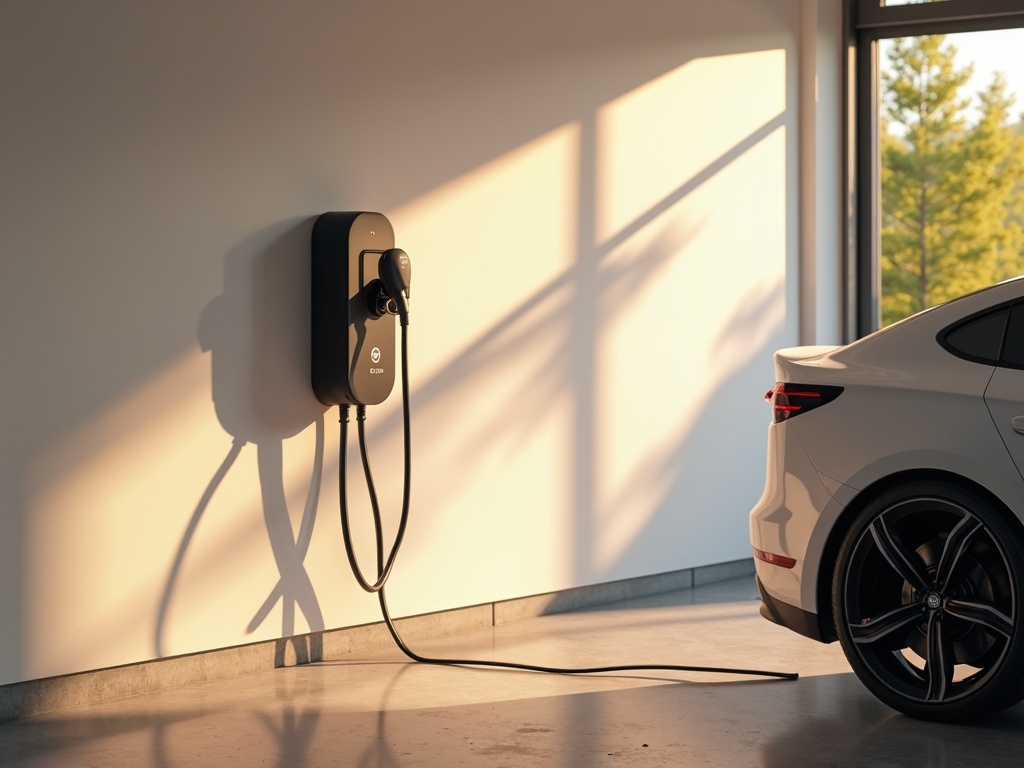
This is where a lot of homeowners get surprised. If your panel is undersized or already maxed out, the charger installation triggers a full electrical panel upgrade before anything else can happen. In the Scottsdale, AZ / AZ market, a panel upgrade to 200 amps typically runs $2,000–$4,500 depending on scope, utility coordination, and whether the meter base needs replacement. The EV circuit itself — wire, conduit, breaker, and a NEMA 14-50 outlet or hardwired EVSE — generally adds $500–$1,200 on top of that, depending on run length and your garage configuration.
If your panel is already a solid 200-amp service with available capacity, you’re often looking at just the circuit work. That’s the good news. The key is knowing which situation you’re in before anyone quotes you a number — and that requires an honest on-site evaluation, not a phone estimate.
While we’re in the panel, it’s also worth asking about circuit additions and load balancing for anything else you’re planning — a kitchen remodel, an outdoor kitchen, or a pool upgrade. Bundling that work saves you the cost of a second service call later.
What Good Lucid Air EV Charger Wiring Actually Looks Like
The finish matters. In a premium home — the kind you’ll find along Shea Boulevard or in the guard-gated communities off Pima Road — we’re not just running wire, we’re running it in a way that looks intentional. Conduit strapped clean and level, outlet or EVSE mounted at the right height, everything labeled at the panel. It’s also the kind of work that holds up to a home inspector’s scrutiny when you eventually sell, which in a competitive Scottsdale market is not a small thing.
We also use thermal imaging after the install is complete. It’s how we verify there’s no heat buildup at connections — the kind of invisible issue that causes problems six months later. Most electricians don’t do this. We consider it standard.
If you want full visibility into how your home’s electrical load is performing after the charger goes in, we can also pair the installation with a home energy monitoring system — useful if you’re running a solar setup or just want to understand your consumption in real time.
The Lucid Air is a premium vehicle. The infrastructure behind it should match. If you’re in Scottsdale, AZ or anywhere across Maricopa County and you want this done right the first time, call FHR Electric at (602) 492-9999 for a straight, no-surprise quote.