A homeowner near McCormick Ranch called us completely baffled. Half his house had gone dark. The other half still had power — but his refrigerator was grinding, his smart TV had bricked itself, and a lamp was glowing orange. He assumed a utility outage. It wasn’t. It was a Lost Neutral in Electrical Panel, and within two more hours it would have killed several more appliances and potentially sparked a fire inside his walls. Here’s what was really happening — and why this failure moves faster than most homeowners expect.
What a Lost Neutral in Electrical Panel Does to Your Home’s Voltage
Your panel feeds your home on two 120V legs. The neutral wire is the shared return path that keeps those legs balanced. When that connection breaks — at the meter socket, the main lugs, or inside the panel — the two legs stop being anchored to zero and start seesawing against each other.
One leg can climb to 160 or even 180 volts while the other drops to 40 or 60 volts. Whatever is plugged into the high-voltage leg gets hit with power it was never designed to handle. Refrigerator compressors overheat. HVAC control boards fry. Smart home hubs, EV chargers, and medical equipment can be destroyed silently — with no tripped breaker to warn you, because the breaker still reads a “normal” current on its own leg. If you’ve been wondering why lights are flickering in one room, a neutral wire failure upstream is high on the diagnostic list.
A floating neutral is one of the few electrical faults that can destroy appliances, electronics, and wiring simultaneously — while every breaker in the box reads perfectly normal.
Where Neutral Wire Failure Actually Originates
Most people assume the break is inside the panel. Sometimes it is — a corroded lug, a loose neutral bar connection, or a wire never torqued to spec. But in Scottsdale, AZ and across AZ, we see neutral failures just as often at the utility’s meter socket or at the service entrance conductors. Heat cycles here expand and contract metal connections year after year. A neutral wire that was snug in 2005 can work loose by 2025 without anyone touching it.
Older panels are especially vulnerable. If your home was built in the 1970s or 1980s, the neutral bar may have aluminum conductors that have oxidized at the connection point. Our guide on 1970s home electrical panels covers this in detail — aluminum-to-copper connections need anti-oxidant compound and periodic retorquing, and most haven’t seen either in decades. According to the CPSC’s electrical safety guidance, loose or deteriorated connections are among the leading causes of residential electrical fires.
How We Diagnose and Fix It
This is not a reset-the-breaker situation. It requires a licensed electrician with metering equipment — and in our case, thermal imaging — to find the exact failure point first. Here’s our sequence:
- Measure voltage between legs at the panel. A healthy panel reads 240V leg-to-leg and 120V from each leg to neutral. A floating neutral reads something like 160V on one leg and 80V on the other — or worse.
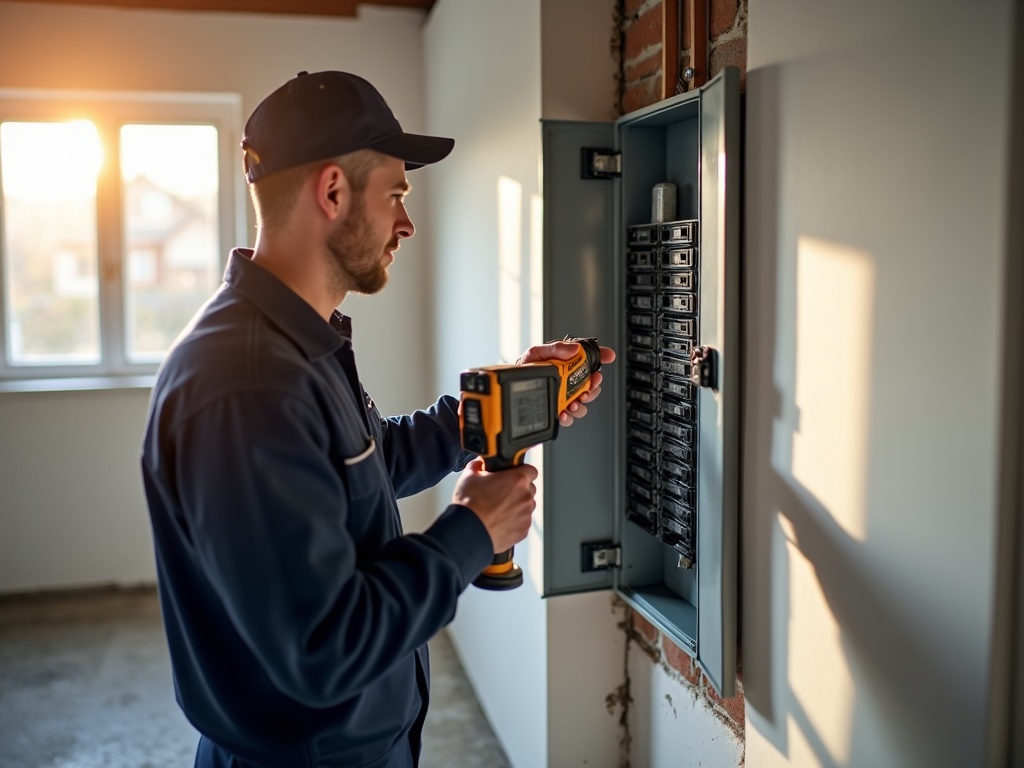
- Run thermal imaging on the panel and meter base. Heat signatures reveal whether the loose connection is inside the panel, at the main lugs, or at the meter socket — without pulling conductors blindly.
- Coordinate with the utility if the fault is at the meter. We make that call for you, document everything, and stay on-site until the repair is verified complete.
- Retorque all neutral connections. Once the primary fault is corrected, every neutral lug gets torqued to manufacturer spec — because a loose neutral anywhere on the bar can restart the problem.
- Test all circuits under load. We verify voltage balance with real appliances drawing current. That’s the only way to confirm the fix held.
- Provide a written report. If appliances were damaged, your homeowner’s insurance may cover replacement — a written report from a licensed contractor supports that claim.
Before you agree to any scope of work, read our honest guide on whether to repair or replace your electrical panel — it’ll help you ask the right questions.
What This Typically Costs
If the neutral failure is a loose lug inside your panel, the repair is relatively straightforward — typically a few hundred dollars for a licensed electrician’s time and service call. If the fault is at the meter base or service entrance conductors, costs climb because the utility has to pull the meter and the socket may need replacement: expect roughly $400–$1,500 depending on equipment condition and permit requirements.
If the imbalance has been running long enough to scorch the bus bars, you’re looking at a panel replacement — which in Scottsdale, AZ typically runs $2,500–$5,000 for standard residential service. That’s a serious number, but it’s a fraction of replacing a refrigerator, two HVAC boards, a smart panel, and an EV charger at once. We give straight pricing before we start — no surprise invoices mid-job.
If your lights are seesawing, appliances are behaving strangely, or you just have a gut feeling something’s wrong with your panel, don’t wait it out. Call FHR Electric at (602) 492-9999 for a same-day diagnostic — we serve all of Scottsdale, AZ and greater AZ with licensed, insured electricians who bring thermal imaging to every panel inspection.