
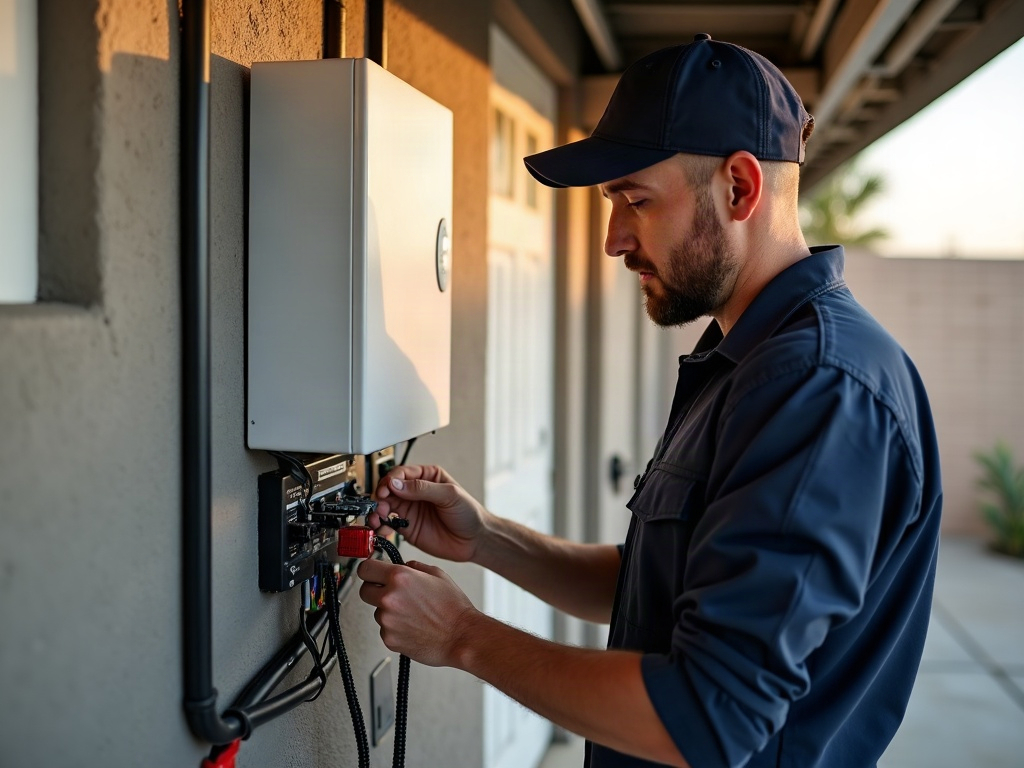
Here’s the honest answer up front: whether Solar Battery Backup Without Grid Tie makes sense for your home depends — on your loads, your panel’s current condition, and how much true independence you actually need. Most homeowners in Scottsdale, AZ ask this question after a summer monsoon drops the grid for six hours and they realize their rooftop solar did absolutely nothing for them. That’s the catch nobody mentions at the sales pitch — solar panels alone don’t keep your lights on when the grid goes down. A battery bank does. And wiring one without a grid-tie connection is a fundamentally different electrical job than a standard grid-tied install.
Two Realistic Paths: Grid-Tied with Backup vs. True Off-Grid Storage
Grid-Tied + Battery Backup
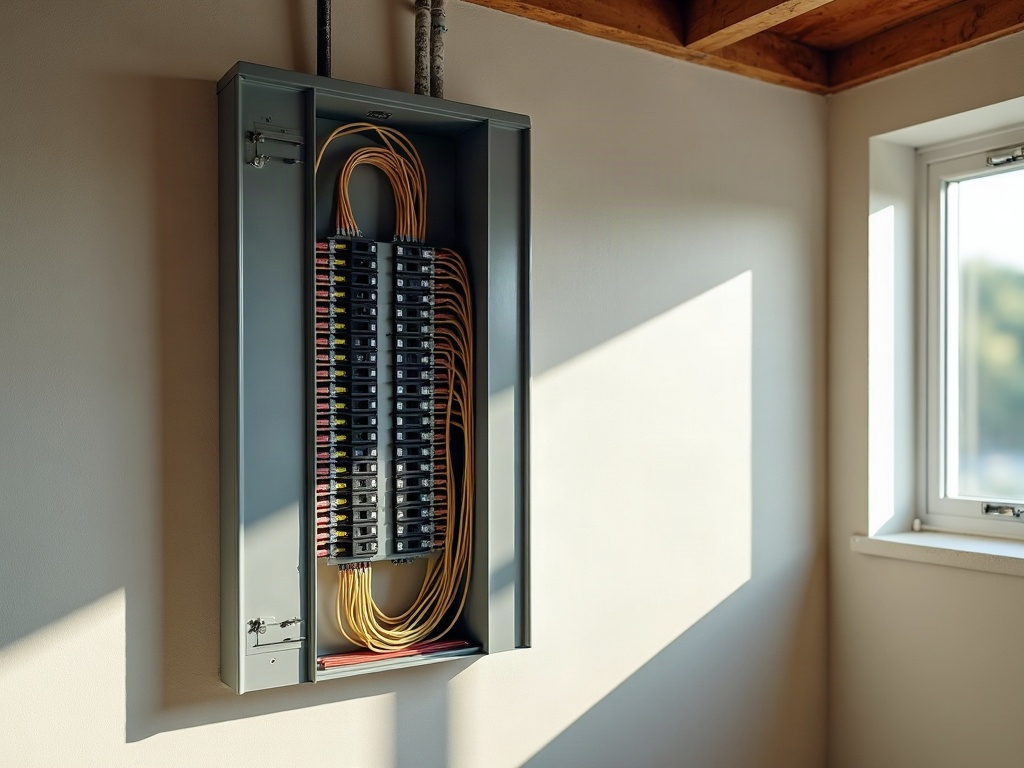
- Solar and battery both connect to the utility grid
- Anti-islanding protection cuts your solar when the grid fails — unless the battery has a built-in transfer switch
- Simpler permitting in most Maricopa County jurisdictions
- Lower upfront wiring complexity
- You still pay a utility bill; battery covers outages only
Off-Grid Battery Storage (No Grid Tie)
- Solar charges the battery; battery powers your home directly
- No utility interconnection agreement required
- Requires a dedicated charge controller, inverter, and critical-load subpanel
- Wiring complexity is significantly higher — sized for sustained, real-world loads
- True independence: no bill, no grid dependency, no anti-islanding conflict
What Tips the Decision Your Way
Not every home in Scottsdale, AZ is a good candidate for a fully off-grid battery setup. A few factors that matter most:
- Your panel’s available capacity. A 100-amp panel serving a full household — plus an EV charger and new HVAC — is already working hard. Adding a battery inverter without addressing the panel first is a mistake. Read our guide on whether to repair or replace your electrical panel before committing to any storage system.
- Critical loads vs. whole-home power. Most battery systems in the $10,000–$25,000 installed range realistically cover a critical-load subpanel — refrigerator, lighting, medical equipment, a few outlets — not every circuit in the house. Whole-home battery coverage costs significantly more and demands larger conductor sizing throughout.
- Arizona’s solar hours. The Phoenix metro averages around 299 sunny days a year, which is genuinely excellent for solar recharge. But summer monsoon season (July through September) can string together cloudy days that stress undersized battery banks.
- Your existing wiring condition. If your home has aluminum branch-circuit wiring or an aging panel, those issues get addressed before any storage system goes in — full stop.
The Electrical Work Behind Off-Grid Battery Storage Wiring
This is where the job gets specific — and where a lot of homeowners discover their original installer cut corners. A properly wired solar and battery storage combo without a grid tie involves several distinct components working together:
- Charge controller — sits between the solar array and the battery bank; manages voltage and prevents overcharge. MPPT controllers are standard for larger residential systems.
- Battery bank and inverter — the inverter converts DC stored energy to the 120/240V AC your home uses. For systems like the Franklin whole home battery, the inverter is integrated, but the wiring to your panel is still a licensed electrical job.
- Critical-load or whole-home subpanel — a dedicated subpanel fed by the inverter output separates the circuits the battery supports from those it doesn’t. Installing that subpanel correctly is one of the more involved pieces of this scope.
- Automatic transfer logic — even without a grid tie, you need switching logic that prevents backfeed and manages load shedding when the battery drops below a set threshold.
- Conductor sizing and conduit runs — every wire in the system is sized for the actual continuous load, derated for AZ‘s ambient temperatures, and run in conduit per NEC and local Maricopa County amendments.
The battery is only as reliable as the wiring behind it. A correctly sized conductor run and a properly configured subpanel are what make the difference between a system that holds up through a three-day monsoon outage and one that trips on day one.
Franklin whole home battery wiring, in particular, gets asked about a lot in North Scottsdale and around the McCormick Ranch area. The Franklin system is well-engineered, but it still requires a licensed electrician to handle the interconnection, the dedicated circuit protection, and the inspection sign-off. The battery itself doesn’t make the wiring compliant — the electrician does.
The National Electrical Code (NEC) Article 706 governs energy storage systems specifically — and Arizona has adopted it with local amendments. Any licensed electrician working this job in Scottsdale, AZ or the surrounding metro should know those amendments cold.
The Verdict: Who Should Go Off-Grid vs. Grid-Tied with Backup
If you’re a homeowner running a home office or medical equipment, or if you own a business where backup power for critical loads is non-negotiable, a properly wired off-grid storage setup offers real peace of mind. If your goal is mainly bill reduction with occasional outage coverage, a grid-tied system with battery backup is usually the cleaner, less expensive path — provided your panel is in good shape to begin with.
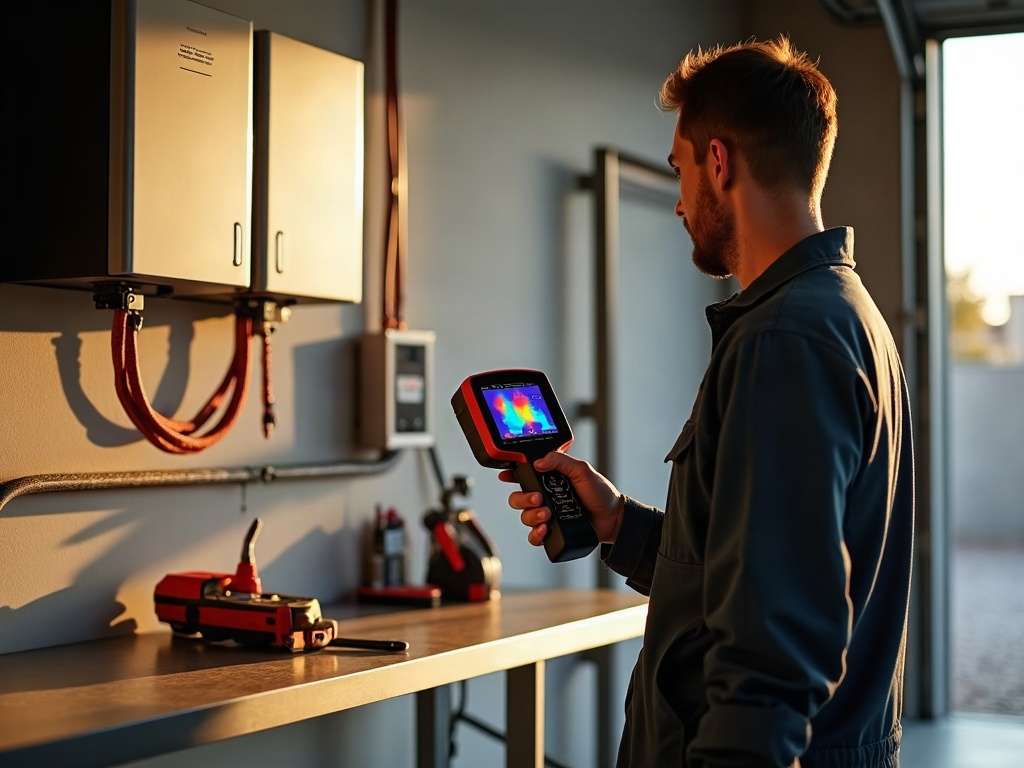
Either way, the electrical scope is real work. It’s not a solar company’s side job. We come in after — or alongside — your solar installer to handle the panel evaluation, the subpanel build-out, the conductor runs, the inspections, and the thermal imaging that confirms everything is performing safely once it’s live. That last part matters more than people realize; thermal imaging catches connection issues that a visual check simply misses.
If you’re in Scottsdale, AZ or anywhere across Scottsdale, AZ and Maricopa County and you’re trying to figure out which path actually fits your home, call FHR Electric at (602) 492-9999 for a straight conversation. We’ll give you an honest scope — not a sales pitch — and a clear price before anyone picks up a tool.

